

How to build SEO topical authority in your niche
Building a topical authority is often an overlooked factor that can rank your brand website above the competitors. It signals the Google search engine that you have vast knowledge in a specific niche, and that your content is worth showing to its audience.
Stuffing any sort of article with keywords is not an effective strategy to build topical authority. It needs at least basic SEO skills and an understanding of the whole concept of topical authority. That is why, in this article, we will cover what topical authority is and how to build one related to your niche.
To build topical authority around any topic you have to cover each nitty gritty of a topic. if someone comes to your website for a specific subject he must find everything in your website, when one doesn’t have to go out of your website for that topic, it means you are an authority in that subject.
What Is Topical Authority
Topical authority is a concept of SEO that shows a website’s expertise in one or more specific topics. Its underlying mechanism is that by regularly posting in-depth and related content on the topic, users and Google consider you a subject matter expert and help you get higher rankings.
Overall, it shows you are an expert with expert knowledge and grip on a topic no one else provides. In SEO, the term “niche” refers to a specific topic. In the broad topic “Global SEO for international companies”, “SEO services in London” would be a niche.
Authority within a niche refers to the credibility and knowledgeability of a topic. It shows the ability to provide beneficial and comprehensive details tailored to meet the target audience.
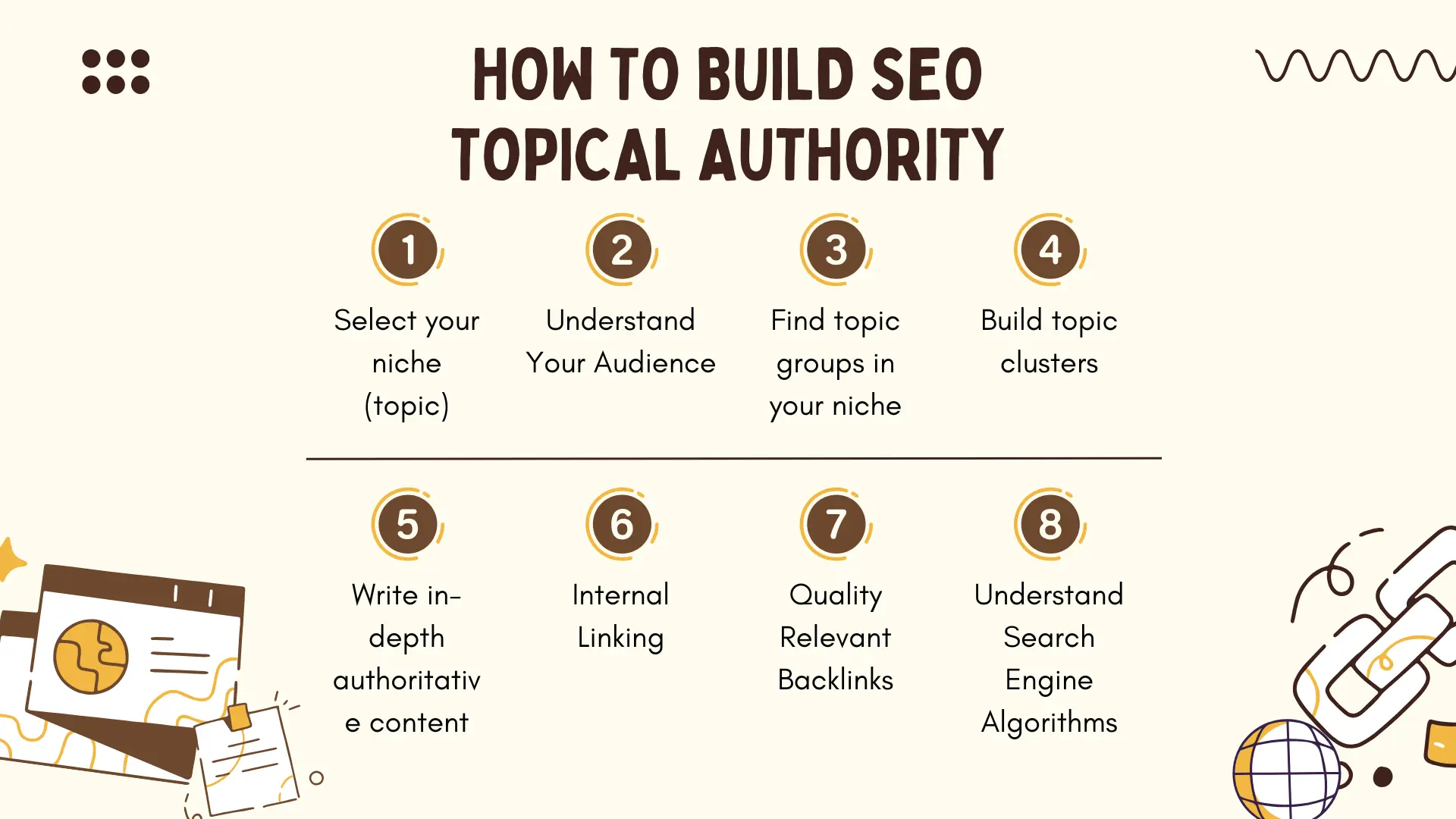
How to Build Topical Authority
Following are the ways/methods/steps to build a topical authority in your niche to outrank your competitors in SERPs.
1. Select your niche (topic)
The first step in building topical authority is topic-based keyword research to select a proper niche. You can choose a narrow niche or a broader niche, its totally up to what you want to achieve.
However, it should be carefully chosen to avoid being too narrow and difficult to describe effectively. Before moving ahead, the understanding of the audience is also very important.
2. Understand Your Audience
You should research what the target audience is looking for, what type of content they find interesting, and what gaps/questions need to be addressed.
For a niche “SEO services in London,” one will need to cover everything related to it. For example other keywords may also include “Local SEO London”, “SEO expert London”, and “Best SEO consultant in London”, etc.
Apart from that users may also look for things like what to ask an SEO consultant, SEO guide for businesses in London, etc. These keywords may not have any search volume in tools but potentially this would help search engines understand that you are creating useful content for users. Hence, there’s a good chance that your website will rank based on topical coverage.
3. Find topic groups in your niche
If you aim to be prominent in search results on some niche topics you should create groups of related content. This approach is time-saving compared to competitive and broad industry topic coverage.
Related keywords are essential to make a group of related topics because they facilitate the creation of a cohesive list of topics offering comprehensive coverage of the content. At this stage, you can also get help from some tools like Semrush, Ahrefs, etc to enter a few keywords and get a list of narrowed subtopics related to your niche.
Search Engine Result Pages (SERPs) are also a great source for finding semantically related topics for better coverage. SERPs help by offering Google auto-complete, people also search for, and people also ask for options. Topic groups should be covered to gain topical authority.
For a niche “SEO services in London”, topic groups can include “How do local SEO services benefit London-based businesses”, “Tools and tips for SEO experts in London”, “Developing content for London’s Competitive Market”, “Why do entrepreneurs in London need SEO services”, “Case-Study: Businesses in London getting higher ranks with SEO”, etc.
4. Build topic clusters
Topic clusters are a strategic way of organizing related subtopics around the core topic for effective structuring and coverage of content. To streamline your workflow, you can draft your content’s complete outline in Google Docs or MS Office files.
From here you can finalize a structure for your main page (also called pillar page) and subpages (supporting cluster pages), and you can internally link them together. The pillar page provides a broad overview of the topic and the cluster pages provide deep information related to subtopics.
The next step is to link these content pages internally. This setup signals the search engines that your site offers more knowledge about a specific topic. Suppose your main page is “Step by Step guide to SEO services in London”, subpages may focus on topics such as “Tips for SEO experts in London”, “Case-Study: role of SEO in highly ranked Businesses in London”, etc.
The use of London-based keywords will increase the topic’s relevance. So, this overall improved organization enhances the visibility and understanding of your site’s structure to both Google and your users.
5. Write in-depth authoritative content
After developing an outline for the topic and subtopics, it’s time to create quality content based on keyword research and topic clusters. Start writing from the pillar page. The pillar page is the central piece of content to establish topical authority.
So, be specific (instead of being general) while writing here. Also, the content on the pillar page should be vast enough to include many sub-categories to target, making them relevant as they explore your web page. Supporting pages should be written to provide more in-depth and related knowledge about a topic.
To ensure high-quality content, one should keep a few points in mind such as: writing accurate, up-to-date, trending, relevant, and informative content about a topic according to the interest of the target audience.
The next point is to keep E-E-A-T (Experience, Expertise, Authoritativeness, Trustworthiness) in mind, for effective and credible synthesis of findings. You must focus on covering a wider range of relevant topics and subtopics.
Also, keep updating your content to meet the requirements of users and search engines. These points will be helpful to achieve topical authority and increase SEO rankings.
6. Link building
In link building, both external and internal links or a combination will be major contributors to building topical authority for your website. They will ensure you are a trustworthy and knowledgeable source in your niche.
When you add relevant and high-quality external links as backlinks (links from other websites added as citations and references to your content), it helps the search engines to recognize you as a niche expert. This is achieved by adding more recent, original research, case studies, etc.
Another approach is to use internal links. Here you will link your pillar page and supporting cluster pages. This linking offers easy navigation, facilitating visitors to explore more detailed and insightful content and view your related subtopics completely.
A cohesive interlinking decreases the risk of orphaned pages and ensures that your content is valid and helpful in answering the queries of the searchers. Moreover, this interconnection of links boosts your website’s crawlability, and page indexing helps in rankings of your website.
Topical Authority Vs Domain Authority
| Topical Authority | Domain Authority |
|---|---|
| It refers to the strength of knowledge about a particular topic | It refers to the overall strength of the domain or website |
| The main factor for building topical authority is focused, deep, and insightful knowledge about a topic | The main factor for building domain authority is topical authority + domain age + backlinks |
| It is determined by the quality and depth of the content | It is determined by the domain’s, popularity, age, and overall profile links |
How to measure topical authority
Until now, no single, precise, and definite formula has been developed to measure the topical authority. However, some quantifiable indicators can be tracked to measure the topical authority.
You can check organic search traffic, keyword ranking, backlinking, topical clusters, and social engagement. In addition, you should keep tracking your website’s performance in SERPs and audience interaction with your content. Continuously checking these factors and applying strategic adjustments will help your site become a trusted and top-ranked source in your niche.